Table of Contents
The 2026 SAP Migration Surge: The 2027 Maintenance Deadline & Cloud ERP Acceleration
As the enterprise software landscape moves through 2026, the global SAP ecosystem is experiencing an unprecedented surge in modernization activity. With the December 2027 deadline for the end of mainstream maintenance on legacy SAP Enterprise Central Component (ECC) systems fast approaching, C-suite technology leaders face an absolute operational mandate to execute system conversions. For SAP consultants, enterprise architects, and technical specialists, this macroeconomic deadline creates extraordinary market leverage. Enterprise software transformations are no longer discretionary multi-year strategic explorations; they are time-critical operational imperatives. This structural supply-demand imbalance directly inflates the market valuation of professionals who can execute complex S/4HANA deployments, remediate technical debt, and ensure business continuity without disrupting daily operations.
According to the SAP insider 2026 ERP Migration and Transformation report (surveying 296 community members between December 2025 and March 2026), enterprise adoption of modern SAP platforms has reached a decisive tipping point. While deployment metrics are accelerating, the operational reality reflects a multi-speed transition landscape:
| Adoption / Switching Metric | Percentage of Organizations | Strategic Operational Reality |
|---|---|---|
| Deployed S/4HANA / Cloud | 55% | 29% have deployed on-premise S/4HANA; 26% have deployed S/4HANA Cloud (Public or Private). |
| Switched Daily ERP | 34% | Reflects organizations that have fully executed daily operational cutovers to S/4HANA. |
| Switching in 2026 | 26% | Represents active transformation initiatives executing production cutovers within the current calendar year. |
| Switching Before Dec 2027 | 22% | Indicates enterprise projects racing directly against the end-of-mainstream-maintenance deadline. |
| Switching After 2027 / No Plans | 14% | Comprises 6% planning post-2027 cutovers, 8% re-evaluating in 12 months, and 4% with no transition plans. |
The gap between total platform deployments (55%) and completed daily ERP cutovers (34%) reveals a central market reality: multi-system architectural footprint complexity. Large enterprises are rarely positioned to execute a single, monolithic “big bang” migration. Instead, they must run parallel landscapes during conversion, manage multiple ERP instances across global subsidiaries, and harmonize disparate legacy baselines (such as SAP ECC 6.0 EHP 6–8 or Business Suite on HANA). Managing dual systems while maintaining transactional integrity creates significant market demand for specialized migration talent proficient in hybrid landscape architecture, data harmonization, and automated system conversions.
Understanding the internal strategic drivers and friction points shaping these transformations allows consultants to position their services at top market rates. Enterprise IT decision-making is governed by specific internal catalysts and external headwinds:
- Primary Transformation Drivers: The approaching end of mainstream maintenance remains the single largest driver of ERP strategy (57%), followed closely by the urgent mandate to update or re-engineer core processes to eliminate legacy architectural anti-patterns and unstandardized process debt (39%), and the requirement to support changing market dynamics (30%). Additionally, 22% of enterprises are driven by an executive mandate to integrate generative AI capabilities into their core business workflows.
- Primary Migration Barriers: Transition strategies are severely constrained by the increased cost of cloud-based infrastructure and deployments (63%) and an inability to construct a compelling internal business case or financial ROI model for S/4HANA (50%). Furthermore, the complexity of custom legacy code implementations poses a major obstacle for 38% of organizations.
From an Enterprise Architecture perspective, these friction points are intrinsically linked: un-remediated custom code and bloated legacy database footprints directly expand SAP HANA in-memory (RAM) hardware requirements, driving up cloud hosting total cost of ownership (TCO) and eroding the project’s financial business case. Consequently, high-value consulting capabilities have shifted beyond simple technical configuration toward structural business case development, data footprint reduction, and custom code remediation. Enterprise clients actively deploy diagnostic tooling—specifically SAP Readiness Check (leveraged by 48% of transforming organizations), SAP Signavio / Process Discovery (37%), and Clean Core setup and analysis tools (33%)—to evaluate landscape risk. Consultants who can interpret these diagnostic outputs to eliminate obsolete custom code, minimize HANA memory overhead, and establish standardized workflows command the highest tier of advisory rates.
This organizational drive to modernize without disrupting core business operations aligns directly with the foundational architectural paradigm powering all contemporary S/4HANA deployments: SAP Business Technology Platform.
2. The Architectural Imperative: SAP BTP, Clean Core, and AI Integration
The core architectural philosophy of SAP engineering has fundamentally transformed. The legacy paradigm of making monolithic core modifications and accumulating custom technical debt inside the ERP application layer is officially obsolete. In 2026, deep competence in SAP Business Technology Platform (BTP) is no longer an optional secondary skill set; it is an mandatory requirement for long-term career viability. BTP functions as the strategic foundation for modern SAP ecosystems, serving as the unified environment where cloud-native development, side-by-side extensibility, enterprise analytics, and artificial intelligence converge.
At the center of this paradigm is SAP’s strict “Clean Core” mandate. Under this policy, direct modifications to the underlying S/4HANA core software layer are prohibited. All enterprise extensions and custom business logic must be built as decoupled “side-by-side extensions” hosted on SAP BTP. The operational imperative driving this policy is lifecycle upgradeability: while on-premise S/4HANA platforms typically receive annual release updates, S/4HANA Cloud environments operate on quarterly release cycles. Without Clean Core isolation on BTP, multi-tenant release cycles break custom business logic, forcing expensive, non-value-add remediation projects during every upgrade cycle. By insulating the core, developers utilize the SAP Cloud Application Programming Model (CAP), ABAP RESTful Application Programming Model (RAP), SAP Build Apps, and SAP Build Process Automation to build resilient, cloud-native extensions while preserving an uncompromised ERP core.

To architect and deliver within this cloud-native framework, consultants must master the four functional pillars of the SAP Business Technology Platform:
- Pillar 1: Application Development & Automation
- CAP & RAP: Frameworks for constructing enterprise-grade cloud applications (CAP via Node.js/Java) and modern cloud-native ABAP extensions (RAP) directly optimized for SAP HANA.
- SAP Build: A low-code/no-code suite comprising SAP Build Apps for rapid application development, SAP Build Process Automation for visual workflow design and Robotic Process Automation (RPA), and SAP Build Work Zone for digital workspaces.
- Runtime Environments: Managed enterprise container runtimes, including Cloud Foundry and Kubernetes-native Kyma.
- Pillar 2: Data & Analytics
- SAP Datasphere: A unified data layer providing semantic business context, real-time data modeling, and data virtualization across hybrid enterprise ecosystems.
- SAP Analytics Cloud (SAC): An enterprise SaaS solution unifying business intelligence, predictive analytics, and enterprise planning scenarios.
- SAP Business Data Cloud (BDC): An enterprise platform architecture designed for cross-system data harmonization across complex hybrid cloud estates.
- Pillar 3: Integration
- SAP Integration Suite: The core middleware engine (formerly CPI) utilized to orchestrate integration flows (iFlows), manage B2B connections, and connect SAP to non-SAP environments.
- API Management & Event Mesh: Infrastructure for designing, governing, and scaling REST/SOAP APIs and event-driven architectures for real-time asynchronous processing.
- Model Context Protocol (MCP) Gateway: Dedicated architectural gateway infrastructure allowing autonomous AI agents to interface securely with backend enterprise data and third-party systems.
- Pillar 4: AI & Intelligent Technologies
- SAP AI Core & AI Launchpad: Scalable infrastructure for deploying, executing, and lifecycle-managing enterprise artificial intelligence and machine learning models.
- Generative AI Hub: A central governance interface within SAP BTP granting secure access to leading foundational LLMs while enforcing strict data privacy standards.
- SAP Joule & Joule Agents: SAP’s contextual generative AI assistant embedded natively across business processes. Advanced Joule Agents execute multi-step workflows across SAP and external ecosystems via the MCP Gateway.
The practical impact of this platform architecture is further heightened by SAP’s expansion of its Industry AI capabilities across 26 enterprise verticals at SAP Sapphire 2026. Because these intelligent capabilities are delivered natively through BTP, 36% of SAP professionals are actively prioritizing skill development across BTP and AI integration. Enterprise leaders recognize that BTP is no longer just a technical middleware option, but the operational engine required to unlock process automation, clean core stability, and AI-driven business capability.
As enterprises aggressively deploy these platform architectures to protect their cloud ERP transformations, credentialed validation of platform expertise has become the premier differentiator for high-value talent acquisition.
3. High-Value Certification & Career Specializations in 2026
The market evaluation of professional SAP credentials has undergone a structural shift. Traditional certifications that relied on static, multiple-choice recall have lost their ability to command premium compensation. In 2026, targeted credentials serve as catalysts for rapid salary and contract rate expansion, but only when backed by documented project delivery experience. Employers utilize modern certifications as a critical risk-reduction filter, ensuring that candidates possess verified, hands-on delivery capability before entrusting them with complex cloud transformation programs.
The economic logic governing SAP professional compensation is driven by three core market variables—the “Pay Value Engine”:
- Business-Criticality: Work that directly impacts financial accounting, legal compliance, corporate governance, or continuous system availability carries elevated operational risk. Capabilities that protect the financial close, guard enterprise authorization models, or prevent revenue-impacting system downtime command higher rates because human error carries direct financial liability.
- Scarcity: Compensation scales inversely with talent availability. Specialized BTP platform skills, cross-system integration architecture, and cloud-native development competencies sit within thin talent pools, driving competitive market bidding by hiring organizations.
- Complexity: Technical and functional domains requiring multi-year learning curves—such as enterprise data engineering, event-driven integration, and Clean Core landscape design—resist rapid commoditization, preserving multi-year rate premiums.
From an executive positioning perspective, professionals must recognize the structural distinction between Associate-level (C_) and Professional/Architect-level (P_) credentials. While an Associate certification (such as C_TS4FI or C_ABAPD) validates foundational baseline competence, a Professional/Architect credential (such as P_BTPA) explicitly presumes years of hands-on project delivery and system execution. Attempting advanced P_ credentials without backing real-world execution creates a disconnect that experienced enterprise recruiters and hiring managers easily identify.
To maximize career trajectory, candidate skill acquisition must align with credentials that exhibit high criticality, scarcity, and complexity. The following matrix outlines the primary high-value SAP certifications in 2026:
| Certification & Domain | Exam Code | Strategic Value Driver | Typical Market Demand Profile |
|---|---|---|---|
| S/4HANA Finance | C_TS4FI | Foundational operational requirement; central to financial reporting, Universal Journal (ACDOCA), and actual costing compliance. | Broad, steady demand across virtually all enterprise transformation programs. |
| ABAP Cloud Development | C_ABAPD | Modern RAP/CAP execution engine required for Clean Core extension development; high technical complexity. | Strong, growing demand where custom development, legacy code conversion, and extensibility are required. |
| BTP Administration | C_ADBTP | Essential operational governance credential for hybrid and cloud-native landscapes; scarce technical specialist skill set. | Rapidly expanding as enterprise programs migrate to side-by-side extension architectures. |
| Solution Architect BTP | P_BTPA | Senior-level landscape design authority; combines complex cross-system integration, governance, and technology strategy. | Highly specialized, top-tier compensation profile; explicitly presumes years of hands-on delivery experience. |
| Analytics & Data | C_BW4HC_SAC | Powers enterprise-wide decision-making through SAP Datasphere, data modeling, and SAP Analytics Cloud (SAC). | Durable, widening demand as enterprise data volumes and real-time business intelligence requirements expand. |
| Security & Authorizations | C_SEC | Critical risk reduction credential governing identity lifecycle, authorization models, GRC compliance, and system defense. | Niche, highly specialized demand profile; driven by risk criticality and severe talent scarcity. |
A key factor elevating the market authority of these credentials in 2026 is the performance-based nature of SAP’s modern evaluation formats:
- System-Based Assessment (SyBA): Candidates are evaluated on their practical ability to execute live tasks, system configurations, and development scripts within an active SAP environment during the exam.
- Scenario-Based Assessment (SBA): Candidates must analyze multi-layered business problems, evaluate system constraints, and solve interconnected enterprise scenarios.
Because performance-based exams test applied execution rather than passive memorization, holding a modern certification serves as a reliable proxy for real-world execution capability. Consequently, credentialed professionals achieve shorter recruitment cycles and secure placement in higher compensation bands.
This credentialed skill set translates directly into specific enterprise roles, driving variable financial rewards across technical and functional career paths.
4. Functional vs. Technical Paths & Compensation Trajectories
Choosing a career specialization within the 2026 SAP ecosystem requires evaluating the structural divergence between functional business consulting and technical platform engineering. Functional consultants focus on process design, business domain integration, and configuring application software to match organizational workflows. Technical consultants focus on cloud platform administration, modern software engineering, integration pipelines, and landscape architecture.
                  ┌────────────────────────────────────────┐
                  │          SAP CAREER PATHWAYS           │
                  └───────────────────┬────────────────────┘
                                      │
           ┌──────────────────────────┴──────────────────────────┐
           ▼                                                     ▼
┌─────────────────────┐                               ┌─────────────────────┐
│  FUNCTIONAL DOMAIN  │                               │  TECHNICAL DOMAIN   │
├─────────────────────┤                               ├─────────────────────┤
│ • Finance (FICO)    │                               │ • ABAP Cloud (RAP)  │
│ • Materials (MM)    │                               │ • BTP Integration   │
│ • Sales (SD)        │                               │ • AI/ML Specialist  │
│ • Production (PP)   │                               │ • Basis / Admin     │
│ • Human Capital     │                               │ • Citizen Dev Lead  │
└──────────┬──────────┘                               └──────────┬──────────┘
           │                                                     │
           └──────────────────────────┬──────────────────────────┘
                                      ▼
                         ┌──────────────────────────┐
                         │   HIGH-PREMIUM HYBRID    │
                         │ Functional + BTP Exten.  │
                         └──────────────────────────┘
A detailed comparative analysis reveals the distinct operational focus of these primary domains:
1. Functional Core Domains
- Finance & Controlling (FICO): Sits at the structural center of S/4HANA transformations, focusing on Universal Journal architecture, financial closing automation, and managerial accounting.
- Materials Management (MM) & Procurement: Oversees end-to-end sourcing, inventory management, and master data transitions (specifically the shift to central Business Partners).
- Sales & Distribution (SD): Drives order management, pricing execution, and customer billing workflows within digital supply chains.
- Production Planning (PP): Focuses on manufacturing execution, capacity planning, and embedded PP-DS scheduling engines.
- Human Capital Management (HCM / SuccessFactors): Manages core HR, workforce analytics, and talent acquisition across hybrid cloud environments.
2. Technical & Platform Domains
- ABAP Cloud / RAP Developer: Focuses on cloud-native ABAP development using Core Data Services (CDS) and RESTful Application Programming models to deliver Clean Core extensions.
- BTP Integration Specialist: Builds, governs, and maintains enterprise integration flows (iFlows), APIs, and event-driven pipelines using SAP Integration Suite.
- AI/ML Specialist: Configures SAP AI Core, manages model deployments through Generative AI Hub, and integrates Joule Agents with backend business processes.
- Basis & System Administrator: Manages infrastructure provisioning, cloud platform security, transport management, and environment maintenance.
- Citizen Developer Enablement Specialist: Governs low-code/no-code adoption, guiding business units in utilizing SAP Build Apps and Build Process Automation securely.
3. The High-Premium Hybrid Professional
While traditional functional and technical tracks offer clear progression, market compensation data reveals that the highest premiums are consistently awarded to cross-functional hybrid professionals. An expert who combines deep functional domain knowledge with practical BTP extensibility capabilities (for instance, an S/4HANA Finance consultant capable of designing custom side-by-side financial models in SAP Analytics Cloud and Datasphere) eliminates the communication gap between business units and IT engineering.
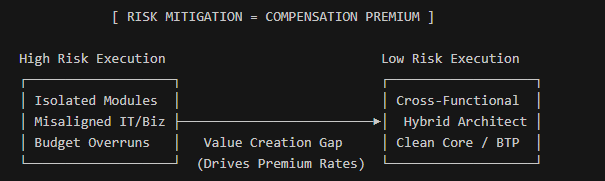
Enterprise clients pay top-tier rates to hybrid architects because they directly mitigate project risk—preventing misalignment between business requirements and platform execution that leads to budget overruns and operational disruption.
               [ RISK MITIGATION = COMPENSATION PREMIUM ]

   High Risk Execution                            Low Risk Execution
   ┌───────────────────┐                          ┌───────────────────┐
   │ Isolated Modules  │                          │ Cross-Functional  │
   │ Misaligned IT/Biz ├─────────────────────────►│  Hybrid Architect │
   │ Budget Overruns   │   Value Creation Gap     │ Clean Core / BTP  │
   └───────────────────┘  (Drives Premium Rates)  └───────────────────┘
Compensation benchmarking across primary geographic markets highlights the earning potential for qualified SAP professionals in 2026:
India Compensation Banding (LPA & Monthly Entry)
- Fresher (0–1 year): ₹4.5 LPA – ₹6.5 LPA (BTP-trained fresh graduates entering top-tier global system integrators command entry starting rates of approximately ₹65,000/month).
- Junior Consultant (1–3 years): ₹6.0 LPA – ₹12.0 LPA.
- Mid-Level Consultant (3–6 years): ₹12.0 LPA – ₹20.0 LPA.
- Senior Consultant (6–10 years): ₹20.0 LPA – ₹35.0 LPA.
- Architect / Lead Tier (10+ years): ₹35.0 LPA – ₹87.0+ LPA (Across all experience levels, the national average for established SAP BTP roles sits at ₹30.1 LPA, with specialized BTP Solution Architects commanding top compensation caps of ₹87.9 LPA).
International Contracting & Full-Time Benchmarks
- Germany / European Union Contracting: Senior S/4HANA and BTP integration specialists command daily contractor rates ranging from €700 to €1,200/day.
- United States & United Kingdom: Senior Solution Architects and Lead Enterprise Engineers in major consulting practices earn $150,000 to $220,000+ in base annual compensation.
Across all markets, three pay multipliers determine an individual’s position within a salary band:
- Currency: Demonstrable competence in S/4HANA Cloud and modern BTP side-by-side architectures yields a 20% to 40% salary premium compared to legacy, ECC-only skill sets.
- Scarcity: Earnings scale with the supply-demand gap. Specializing in high-complexity, low-supply domains (such as Solution Architecture, Security/Authorizations, or ABAP Cloud) creates high rate leverage.
- Delivery: While certifications establish baseline candidate credibility, documented execution on live transformation projects commands top-of-band rates.
For experienced consultants whose careers were built on legacy architectures, converting these financial opportunities into reality requires a structured framework to transition legacy knowledge into modern S/4HANA expertise.
5. Actionable Playbook: ECC-to-S/4HANA Transition Strategy
Experienced SAP consultants frequently encounter a career dilemma: enterprise clients require documented S/4HANA project experience before hiring, yet consultants cannot gain that initial experience without being deployed on an active S/4HANA engagement. Overcoming this hurdle requires a systematic upskilling methodology. Legacy ECC experience is not obsolete; it represents a crucial foundation of domain process knowledge that can be systematically re-platformed to modern S/4HANA architectures.
[LEGACY ECC CONCEPT]                                 [MODERN S/4HANA EQUIVALENT]

Vendor/Customer T-Codes  ──►  Redirects  ──►  Business Partner (Transaction 'BP')
(XK01, MK01, FK01, FD01, XD01)

Standalone SAP APO Engine ────────────────►  Embedded PP-DS (Native Core Engine)

Optional Material Ledger ────────────────►  Mandatory Material Ledger (Universal Journal 'ACDOCA')

Direct Core Modifications ───────────────►  Clean Core Extensions (SAP BTP / CAP / RAP)
The baseline of this transition requires mastering the fundamental technical and functional delta changes that distinguish S/4HANA from legacy ECC:
- Materials Management (MM): Legacy vendor and customer creation transactions—specifically
XK01,MK01,FK01,FD01, andXD01—are completely deprecated. Master data creation is consolidated under the centralized Business Partner ( BP ) transaction. In S/4HANA, executing any legacy vendor/customer transaction triggers an automatic system redirection to transactionBP. - Production Planning (PP): Advanced planning tools that previously required a standalone SAP Advanced Planning and Optimization (SAP APO) system are natively embedded within the core ERP as Production Planning and Detailed Scheduling (PP-DS).
- Controlling & Financials (CO/FI): While the Material Ledger (ML) was optional in legacy ECC, its implementation is mandatory in S/4HANA. The Material Ledger is required because the Universal Journal (
ACDOCA) relies on real-time multi-currency valuation and actual product costing to maintain financial compliance.
To execute this career transformation, legacy consultants and freshers should execute this 5-step action plan:
Step 1: Master Simplification Lists & SAP Activate
Review annual SAP Simplification Lists (including release benchmarks 1511, 1610, 1709, and modern Feature Pack Stacks) to understand modified, replaced, or deprecated transactions, database tables, and functional capabilities. Concurrently, replace legacy Accelerated SAP (ASAP) project methodologies with SAP Activate, the agile deployment framework designed for cloud and hybrid transformations. Integrate key diagnostic transformation tools into your methodology, specifically leveraging SAP Readiness Check (used by 48% of enterprise projects), SAP Signavio / Process Discovery (37%), and Clean Core setup tools (33%) to analyze system health.
Step 2: Acquire Hands-On Practice System Access
Theoretical reading is insufficient to build applied capability. Secure hands-on access to live S/4HANA sandbox or trial environments pre-loaded with IDES (International Demonstration and Education System) and SAP Best Practices data. Practicing backend configuration and executing business transactions in an active sandbox solidifies operational competence.
Step 3: Execute Cross-Module Business Process Integration
Break out of isolated module silos by mastering end-to-end cross-functional business processes. Form peer study groups to configure, execute, and troubleshoot complete end-to-end integration flows within live trial systems, specifically:
- Procure-to-Pay (P2P)
- Order-to-Cash (O2C)
- Plan-to-Product (P2D / Plan-to-Product)
- Hire-to-Retire (H2R)
Step 4: Complete Targeted Performance-Based Certification
Validate your hands-on practice by obtaining a role-specific S/4HANA or BTP certification. Utilize resources such as the SAP Learning Hub (Professional or Student Editions) and OpenSAP courses to prepare for System-Based Assessments (SyBA) and Scenario-Based Assessments (SBA). Achieving a performance-based certification verifies to employers that you can execute tasks in live systems.
Step 5: Strategically Re-Frame Your Professional Positioning
Update your resume, LinkedIn profile, and professional collateral. Transition your experience descriptions away from legacy maintenance and re-frame your background around business process transformation, Clean Core compliance, risk reduction, and SAP Activate project execution. Highlight your practical familiarity with S/4HANA delta shifts, transaction BP master data models, Universal Journal integration, and BTP side-by-side extensibility options.
Ultimately, long-term career growth and premium compensation within the 2026 SAP ecosystem belong to those who proactively align their technical delivery capabilities with business-critical cloud transformation.
You might also find the following articles interesting
- autonomous enterprise agentic ai guide
- clean core architecture sap s4hana
- sap joule and agentic
- sap vs oracle the competition the 2026
- sap career 2026 salaries modules certification
- sap 2027 deadline migration guide
- sap eam guide plant maintenance
- basic transportation management in sap s4hana
- mastering sap s4hana cloud public edition
- sap extensibility guide
- sap brim comprehensive guide
- sap business partner in s4hana guide
- blueprint for sap business data cloud
- sap joule sales distribution transformation
- SAP hana custom code migration
- SAP GTS E4H Migration
- Generative ai for sap consultants
- mastering sap mrp practical guide optimize supply chain planning
- enterprise with sap business ai
- sap s4hana transition guide to data migration
- sap clean core
- SAP S/4HANA private cloud 2025
- introduction sap btp for consultants
- sap consultants productivity with joule
- Migration guide to SAP data migration
- SAP btp guide to app development
- Transformation journey 4hana implementation
- Empowering enterprises with SAP solutions


