In the evolving landscape of SAP S/4HANA, the term “Clean Core” has become the North Star for every SAP consultant and developer. Extensibility—the ability to adapt and enhance SAP systems without modifying standard code—is no longer just about adding a field or a user exit; it is about building a sustainable, upgrade-safe, and cloud-ready digital core. Organizations are under constant pressure to innovate while maintaining system stability. This challenge is especially important in modern SAP ecosystems powered by SAP S/4HANA. Businesses need flexibility to customize processes, yet they must avoid damaging the integrity of the digital core.
That is where the concept of clean core architecture becomes essential.
SAP’s modern extensibility strategy enables organizations to adapt systems without modifying standard SAP code. Instead of relying on risky customizations, enterprises can now use upgrade-safe and cloud-ready extension techniques that support innovation while protecting long-term maintainability.
This guide explores the complete extensibility framework in SAP S/4HANA, including key user extensibility, developer extensibility with ABAP Cloud, Side-by-Side extensions using SAP BTP, and classic extensibility. By the end, you will understand how to choose the right extensibility model for your business requirements while keeping your SAP landscape future-ready.
This guide explores the structured framework of SAP extensibility, providing a roadmap for choosing the right tools to meet business needs while ensuring long-term system health.
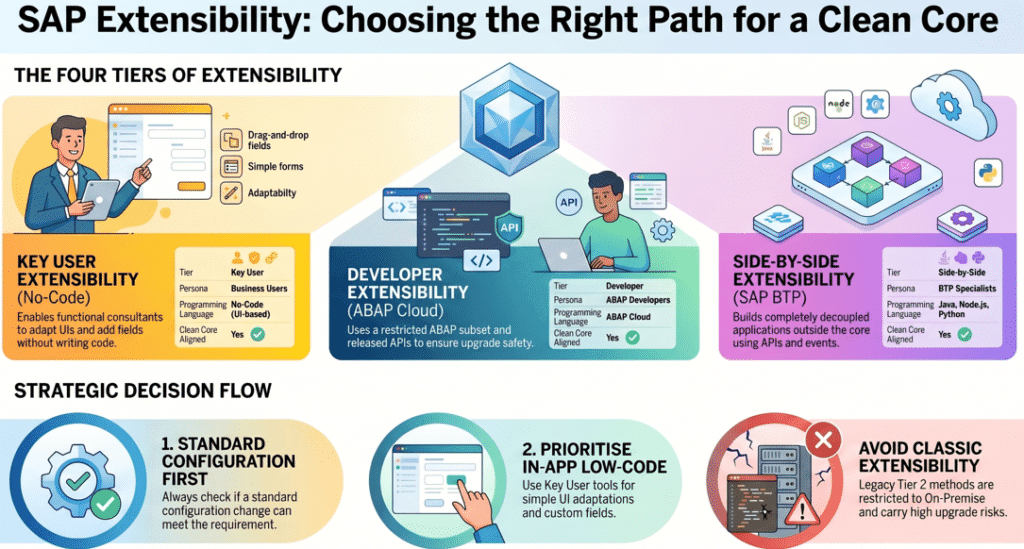
Table of Contents
Understanding Clean Core Architecture
A clean core architecture refers to keeping the standard SAP system free from unnecessary modifications. Instead of altering SAP-delivered code directly, organizations use officially supported extension points and APIs.
This approach ensures that the system remains:
- Upgrade-safe
- Cloud-compatible
- Easier to maintain
- Faster to innovate
- More secure and scalable
The clean core principle is central to SAP’s cloud-first strategy. Whether organizations run public cloud, private cloud, or on-premise deployments, SAP strongly recommends using approved extensibility mechanisms.
Why Extensibility Matters in the Cloud Era
Standard SAP functionality rarely addresses 100% of an enterprise’s unique requirements. Extensibility bridges this gap by tailoring processes to specific industry needs. However, the strategic shift lies in how we extend. By using approved mechanisms, we:
- Preserve upgrade compatibility.
- Reduce maintenance costs by avoiding unsupported modifications.
- Support cloud adoption by decoupling custom logic from the SAP core.
The Extensibility Spectrum: Four Major Types
SAP categorises extensibility into four distinct tiers based on who uses them and where the logic resides:
| Type | Persona | Location | Technical Depth |
| Key User | Functional Consultants | Inside S/4HANA (UI) | No-code / Low-code |
| Developer (Tier 1) | ABAP Developers | Inside S/4HANA (ABAP Cloud) | High (ABAP Cloud) |
| Classic (Tier 2) | Senior ABAP Developers | Inside S/4HANA (Legacy) | High (Classic ABAP) |
| Side-by-Side (Tier 3) | BTP Developers | SAP BTP (Outside Core) | Medium to High |
Key User Extensibility: Empowerment Through No-Code
Also known as In-App Extensibility, this layer allows functional consultants and business analysts to adapt Fiori apps without writing a single line of ABAP.
Core Tools:
- Custom Fields: Allows adding new fields to data objects (e.g., Sales Orders, Business Partners) and automatically publishing them to UIs, APIs, and reports.
- Custom Logic: Enables simple validations or field derivations using a form-based script editor.
- Custom Business Objects (CBO): You can create entirely new, simple entities with their own persistence and Fiori UIs without coding.
- UI Adaptation: Key users can hide, re-label, or re-order fields on Fiori pages directly in the browser.
Developer Extensibility (Tier 1): The Power of ABAP Cloud
For requirements that demand complex logic inside S/4HANA, ABAP Cloud is the strategic choice. This model enforces “Clean Core” by restricting developers to released SAP APIs and objects.
Key Frameworks:
- RESTful ABAP Programming Model (RAP): The strategic framework for building transactional business objects. It handles everything from data modeling with CDS to service binding for Fiori.
- Business Add-Ins (BAdIs): These are the primary hooks for injecting logic into standard processes. Unlike legacy exits, BAdIs are defined at explicit enhancement spots and are upgrade-safe.
- Core Data Services (CDS) Extensions: Used to enhance standard data models with custom fields and associations while maintaining stability through the C1 release contract.
Note: ABAP Cloud blocks the use of obsolete statements and direct access to non-released tables to ensure system stability.
Side-by-Side Extensibility (Tier 3): Decoupling via SAP BTP
Side-by-side extensibility involves building applications on the SAP Business Technology Platform (BTP) that are completely separate from the S/4HANA core.
Why go Side-by-Side?
- Zero Impact on Upgrades: Since the code lives on BTP, S/4HANA upgrades do not affect the extension.
- Language Flexibility: Supports Java, Node.js, and Python, in addition to ABAP Cloud.
- Event-Driven Architecture: Use SAP Event Mesh to trigger logic asynchronously. For example, when a Sales Order is created in S/4HANA, BTP can automatically trigger a third-party notification without slowing down the core transaction.
- SAP Build: Offers low-code tools like SAP Build Apps and Process Automation for rapid application development and workflow management.
Classic Extensibility (Tier 2): Handle with Caution
Classic extensibility includes legacy mechanisms like User Exits, Customer Exits, and direct Append Structures.
Important Governance:
- This is only available in S/4HANA On-Premise and Private Cloud.
- It carries high upgrade risk because it often relies on non-released internal SAP APIs.
- Best Practice: Use Tier 2 only when Tier 1 (ABAP Cloud) lacks a released API, and always plan to migrate these toward Tier 1 as SAP releases new APIs.
Strategic Decision Guide: Which One to Choose?
Selecting the right approach is a critical architectural decision. Consultants should follow this decision tree:
- Can standard configuration meet the need? If yes, do not extend.
- Is it a simple UI change or field addition? Use Key User Extensibility.
- Is complex logic required inside the system?
- If a released BAdI/RAP point exists: Use Developer Extensibility (Tier 1).
- If no released point exists (On-Premise): Consider Classic (Tier 2) with strict review.
- Is it a standalone app or a cross-system workflow? Use Side-by-Side Extensibility (Tier 3).
Extensibility Governance and Lifecycle
To maintain a healthy system, organizations must implement a governance framework:
- Extension Review Board (ERB): A central body to evaluate every extension request and select the appropriate tier.
- Quality Gates: Use the ABAP Test Cockpit (ATC) to enforce Cloud Readiness checks and flag the use of non-released APIs.
- Inventory Management: Maintain a register of all extensions to track business justification and usage frequency.
Conclusion: The Path Forward
The strategic direction from SAP is clear: focus on Key User tools, ABAP Cloud (Tier 1), and Side-by-Side (BTP) extensions. Classic extensibility is no longer a starting point for new development; it is a migration target for modern SAP landscapes—it is a foundational requirement for building sustainable enterprise systems.
The future belongs to organizations that embrace:
- Clean Core principles
- ABAP Cloud
- SAP BTP
- Event-driven architectures
- Upgrade-safe development
By choosing the right extensibility model for each business scenario, enterprises can innovate rapidly while maintaining system stability and reducing long-term operational costs. The strategic direction from SAP is crystal clear: modern extensibility must prioritize agility, governance, and cloud readiness.Organizations that align with this vision today will be far better prepared for tomorrow’s digital transformation challenges.
By embracing these patterns, SAP consultants and developers can build agile, robust systems that are ready for the innovations of tomorrow.
Helpful resources for further learning include:
You might also find the following articles interesting
- sap brim comprehensive guide
- sap business partner in s4hana guide
- blueprint for sap business data cloud
- sap joule sales distribution transformation
- SAP hana custom code migration
- SAP GTS E4H Migration
- Generative ai for sap consultants
- mastering sap mrp practical guide optimize supply chain planning
- enterprise with sap business ai
- sap s4hana transition guide to data migration
- sap clean core
- SAP S/4HANA private cloud 2025
- introduction sap btp for consultants
- sap consultants productivity with joule
- Migration guide to SAP data migration
- SAP btp guide to app development
- Transformation journey 4hana implementation
- Empowering enterprises with SAP solutions
- blackline tool vs traditional process
- Sap cutover plan a comprehensive guide
- Fiori Configuration Guide
- SAP ECC to S4HANA data migration
- earn sap btp
- Retail insights with sap car
- leanix an introductory guide
- building side-by-side extensions on SAP BTP
- sap ecc vs s4 hana key changes and benefits
- sap ides
- Understanding RFNO in SAP s4hana
- SAP Clean Core
- SAP ABAP beginner’s journey
- Grow with sap vs rise with sap comparison
- Rise with sap
- Year-end activities in sap
- SAP TM Transaction codes
- ethical ai development
- sap migration data configuration tools
- s4hana custom code migration
- SAP EWM integration
- sap project intelligence network
- advanced production integration with SAP EWM
- Credit management comparison of sap fscm
- SAP EWM
Frequently Asked Questions
What is SAP Clean Core Architecture?
SAP Clean Core Architecture is an approach that minimizes direct modifications to standard SAP code by using approved extensibility methods and released APIs.
What is the difference between Tier 1 and Tier 2 extensibility?
Tier 1 uses ABAP Cloud and released APIs, making it upgrade-safe. Tier 2 relies on classic ABAP techniques and carries higher upgrade risk.
What is SAP RAP?
The RESTful ABAP Programming Model (RAP) is SAP’s strategic framework for building transactional applications and APIs in ABAP Cloud.
Why is SAP BTP important for extensibility?
SAP BTP enables side-by-side applications that operate independently from SAP S/4HANA, reducing upgrade impact and improving scalability.
Can Key Users extend SAP without coding?
Yes. Key User Extensibility provides low-code and no-code tools for adapting SAP applications and processes.


1 thought on “Mastering SAP Extensibility: A Comprehensive Guide to Clean Core Architecture”