In an era where enterprises demand agility, scalability, and intelligent automation, the need for a unified technology platform has never been greater. Organizations must connect siloed systems, simplify development, and leverage AI to stay competitive. This is exactly where SAP Business Technology Platform (SAP BTP) steps in—serving as the digital backbone for modern enterprises.
SAP BTP provides the tools, services, and frameworks needed to extend SAP S/4HANA, integrate applications, manage data at scale, and adopt advanced analytics and automation capabilities. It brings together four foundational pillars—AI, Analytics, advanced process modelling (APM), and enterprise mobility services (EMS)—to help enterprises accelerate transformation.
Table of Contents
Understanding the Four Pillars of SAP BTP
SAP BTP’s capabilities are organised around four key pillars that enable a holistic approach to enterprise technology modernisation.
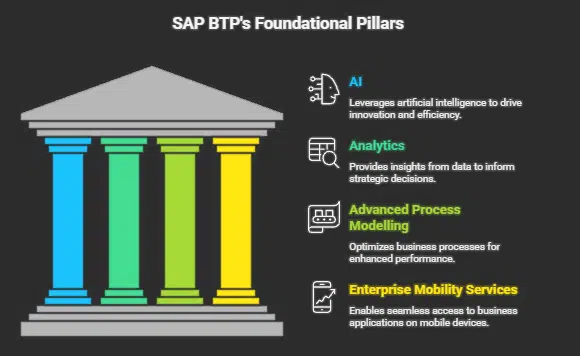
1. Database and Data Management
At the core of this pillar is SAP HANA Cloud, a high-performance, in-memory database optimised for real-time analytics and transactional processing (OLTP + OLAP). Its columnar storage and in-memory architecture deliver unmatched speed and scalability.
Other critical components include:
- SAP Datasphere (formerly SAP Data Warehouse Cloud)
Acts as a central business data fabric, eliminating data silos by integrating structured and unstructured data across systems. Datasphere supports self-service data modeling, semantic layers, and federated governance.
Together, they create a solid data foundation for analytics, AI, and application development.
2. Analytics
This pillar is driven by SAP Analytics Cloud (SAC)—the unified solution for:
- Business intelligence
- Planning and budgeting
- Predictive analytics
- Real-time reporting
SAC integrates seamlessly with SAP and non-SAP systems, allowing decision-makers to analyze, visualize, and act on insights faster than ever.
3. Application Development
SAP BTP supports the creation of cloud-native applications with various runtimes, frameworks, and programming models. Key runtimes include:
- Cloud Foundry – A multi-language, cloud-native platform supporting Java, Node.js, Python, Go, and more.
- ABAP Environment – Enables modern ABAP cloud development while reusing existing ABAP knowledge.
- Kyma – A Kubernetes-based environment ideal for microservices and event-driven architectures.
- Neo – Legacy runtime, gradually being deprecated.
The SAP Cloud Application Programming Model (CAP) further accelerates development by offering:
- Core Data Services (CDS) for data modeling
- Best practices for service development
- Built-in support for OData and SQL
- Automated generation of APIs and artifacts
For low-code/no-code use cases, SAP Build empowers citizen developers through:
- Build Apps
- Build Process Automation
- Build Work Zone
This dramatically reduces development cycles and accelerates time-to-market.
4. Intelligent Technologies
This pillar focuses on AI, machine learning, and IoT-based automation. Key services include:
- SAP Process Automation – Combining RPA, workflow orchestration, and process mining
- IoT services – Device-to-cloud communication and real-time monitoring
- SAP Joule – An AI copilot that uses LLMs to provide contextual assistance and automated insights across SAP systems
These technologies help streamline operations, eliminate manual work, and drive intelligent business decisions.
Architectural Governance in SAP BTP: Accounts, Resources & Limits
SAP BTP follows a hierarchical account model designed for scalability, simplicity, and secure resource segregation.
The Hierarchy
- Global Account
The top-level container managing entitlements, subscriptions, and billing. - Directories (optional)
Logical grouping of subaccounts. - Subaccounts
Operational units where applications, services, entitlements, and configurations are deployed.
Entitlements vs. Quotas
- Entitlements define which services are available for each subaccount.
- Quotas define how much of each service (e.g., memory, storage) can be consumed.
This structure ensures tight cost control, optimized performance, and operational isolation across business units.
Building and Running Applications on SAP BTP
Developers can choose from multiple runtime environments depending on architectural needs:
✔ Cloud Foundry – Ideal for cloud-native apps
✔ ABAP Environment – For modern ABAP cloud applications
✔ Kyma – Kubernetes-driven microservices
✔ Neo – Legacy runtime (phasing out)
Tools that Accelerate Development
- SAP Business Application Studio (BAS)
A cloud-based IDE supporting extensions, debugging, generators, and open-source development tools. - SAP CAP (Cloud Application Programming Model)
The preferred framework for enterprise-grade services and APIs. - SAP Fiori & SAPUI5 for intuitive user interfaces.
- SAP Build for low-code/no-code app development and process automation.
Seamless Integration and Hybrid Connectivity
Modern enterprises operate across a mix of cloud and on-premise systems. SAP BTP simplifies integration through the SAP Integration Suite, which includes:
SAP Cloud Integration (CPI)
Handles technical integration patterns such as:
- Data transformation
- Routing
- Orchestration
- Adapter-based connectivity (HTTP, REST, IDoc, SFTP, Salesforce, etc.)
API Management
Enables secure API creation and lifecycle management, including:
- Security policies
- Rate limiting
- Versioning
- Analytics
SAP Cloud Connector (SCC)
A secure gateway connecting BTP to on-premise systems without exposing internal networks.
SAP Event Mesh
Supports event-driven architecture with:
- Pub-sub messaging
- Real-time updates
- Guaranteed message delivery
- Loose coupling between applications
This makes it easy to build scalable, responsive enterprise architectures.
Security, Compliance, and Identity Management in SAP BTP
Security is integrated at every layer of SAP BTP:
Identity & Access Management
- SAP IAS – Authentication, SSO, MFA
- SAP IPS – Automated user provisioning across systems
- RBAC – Role-based authorization for least-privilege access
Data Protection
- Encryption in transit (TLS/SSL)
- Encryption at rest (AES-256)
- Credential Store for securing API keys, certificates, and secrets
SAP BTP also adheres to major global compliance standards like:
- ISO 27001
- SOC 2 Type II
- GDPR
The Future of SAP BTP
SAP continues to evolve BTP with several key innovations:
- Generative AI Expansion through SAP Joule
- Composable Architecture for modular, rapidly scalable solutions
- Low-Code/No-Code acceleration via SAP Build
- Serverless Computing for event-driven workloads and cost efficiency
Conclusion
SAP BTP unifies application development, data management, analytics, integration, and intelligent technologies into one powerful, cloud-based platform. By leveraging BTP, organizations not only extend the value of SAP S/4HANA but also build future-ready systems capable of supporting automation, AI-driven insights, and scalable digital transformation.
SAP BTP isn’t just a platform—it’s an enabler of the intelligent, connected, and modern enterprise.
You might also find the following articles interesting.
- sap s4hana transition guide to data migration
- sap clean core
- SAP S/4HANA private cloud 2025
- introduction sap btp for consultants
- sap consultants productivity with joule
- Migration guide to SAP data migration
- SAP btp guide to app development
- Transformation journey 4hana implementation
- Empowering enterprises with SAP solutions
- blackline tool vs traditional process
- Sap cutover plan a comprehensive guide
- Fiori Configuration Guide
- SAP ECC to S4HANA data migration
- earn sap btp
- Retail insights with sap car
- leanix an introductory guide
- building side-by-side extensions on SAP BTP
- sap ecc vs s4 hana key changes and benefits
- sap ides
- Understanding RFNO in SAP s4hana
- SAP Clean Core
- SAP ABAP beginner’s journey
- Grow with sap vs rise with sap comparison
- Rise with sap
- Year-end activities in sap
- SAP TM Transaction codes
- ethical ai development
- sap migration data configuration tools
- Simplifying SAP s4hana custom code migration
- SAP EWM integration
- sap project intelligence network
- advanced production integration with SAP EWM
- Credit management comparison of sap fscm
- SAP EWM
- sap s4hana migration
- GST E invoice
- understanding abap objects
- SAP interfaces
- Joule ai copilot
- Mastering sap background job processing
- SAP Ewm tcodes a handy guide
- Object-oriented programming in sap abap
- understanding sap license costs
- SAP Datasphere
- industry4.0 with sap
- Condition contract management in sap s4 hana
- Comprehensive guide to go live
- SAP EHS Module
- Power of generative ai in sap
- SAP Joule Comprehensive Guide
- Mastering the dunning process sap
- Creation of chart of accounts in sap fico
- Different roles of an sap consultant
- understanding sap system landscape
- Product costing in sap
- Copa in sap
- subcontracting process in sap mm
- SAP S4hana cloud
- Disaster Recovery in SAP HANA Cloud


