Table of Contents
Introduction: Why SAP GTS E4H Migration Is Critical for Global Trade
The world of international business is evolving faster than ever. Companies that operate across borders must handle complex customs regulations, trade compliance rules, and constantly changing global trade policies. For many organizations, SAP Global Trade Services (GTS) has long been the backbone of managing these challenges.
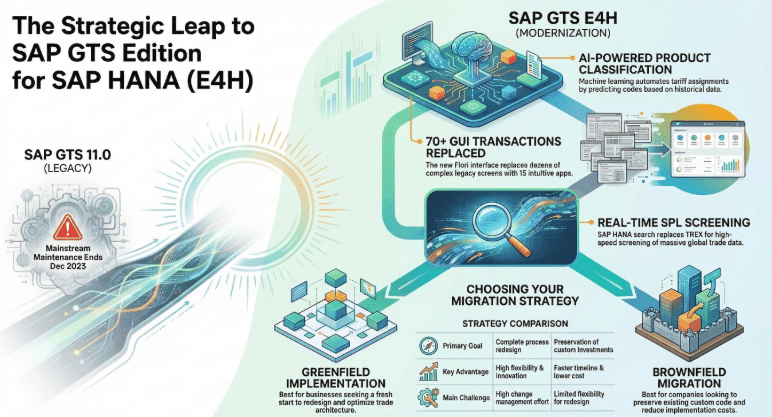
However, a major milestone is approaching. SAP has officially announced that mainstream maintenance for SAP GTS 11.0 will end in December 2025. This means businesses still running the legacy system must begin planning their transition to SAP GTS Edition for SAP S/4HANA (GTS E4H).
This shift is not simply a technical upgrade. It represents a strategic transformation of global trade operations. The new platform is built natively on SAP S/4HANA’s powerful in-memory architecture, enabling faster analytics, AI-driven automation, and deeper integration with modern SAP solutions.
Organizations that migrate early gain a significant competitive advantage. They can streamline compliance processes, reduce operational risks, and leverage modern technology to handle the increasing complexity of global trade.
In this article, we explore 10 powerful benefits of adopting SAP GTS E4H, along with the most effective migration strategies organizations should consider before the 2025 deadline.
Understanding SAP GTS E4H and Its Role in Modern Trade
SAP GTS E4H is the next-generation version of SAP’s global trade management platform. Built on the SAP S/4HANA architecture, it introduces a modern framework for handling:
- Global trade compliance
- Customs management
- Sanctioned party list screening
- Export and import declarations
- Trade preference management
- International reporting and documentation
Unlike older systems, GTS E4H integrates seamlessly with modern SAP environments such as SAP Transportation Management (TM) and SAP Extended Warehouse Management (EWM).
The result is a fully connected global trade ecosystem where trade compliance becomes part of everyday business processes rather than a separate operational function.
Top 10 Advantages of SAP GTS E4H
1. Real-Time Analytics and Business Insights
One of the most significant upgrades in SAP GTS E4H is the ability to generate real-time analytics using SAP HANA’s in-memory database.
Traditional systems rely on batch processing and delayed reporting. In contrast, GTS E4H enables instant visibility into trade operations.
Key Benefits
- Real-time trade compliance monitoring
- Faster decision-making for export and import operations
- Embedded analytics within SAP Fiori applications
- Interactive dashboards with visual filters
For trade compliance teams, this means they can identify risks immediately and take corrective actions without delays.
2. A Modern SAP Fiori User Experience
SAP GTS E4H introduces a completely redesigned user interface powered by SAP Fiori Launchpad.
Previously, users had to navigate through dozens of complex SAP GUI transactions. Now, the system offers intuitive applications designed around business roles and workflows.
Improvements in User Experience
- 15 new Fiori apps replacing over 70 legacy SAP GUI transactions
- Mobile-friendly and responsive design
- Simplified navigation and workflow
- Personalized dashboards
This modern user interface significantly increases productivity and reduces training time for employees.
3. AI-Powered Product Classification
Product classification is a critical task in global trade. Incorrect classification can lead to customs penalties, shipment delays, and compliance violations.
SAP GTS E4H introduces Artificial Intelligence and Machine Learning to automate this process.
AI Classification Capabilities
- Automated tariff code suggestions
- Machine learning based on historical classification data
- Confidence scores for classification predictions
- Reduced manual intervention
By leveraging AI, companies can improve accuracy while saving time and operational costs.
4. High-Speed Sanctioned Party List Screening
Sanctioned Party List (SPL) screening ensures businesses do not trade with restricted or prohibited entities.
In SAP GTS E4H, SPL screening has been dramatically enhanced.
Major Improvements
- Removal of the legacy TREX search engine
- High-performance screening using SAP HANA
- Real-time compliance checks
- Consolidated blocked document management
- Advanced reporting and analytics
Organizations can now process large volumes of transactions quickly while maintaining strict compliance standards.
5. Enhanced Collaboration and Process Monitoring
Global trade processes often involve multiple departments such as logistics, finance, and compliance teams.
SAP GTS E4H improves process transparency and collaboration through modern Fiori applications.
New Collaboration Features
- Manage Export Declarations Fiori app
- Real-time status tracking
- Automated processing proposals
- Integrated communication tools
Teams can easily monitor document progress, resolve issues faster, and collaborate efficiently.
6. Simplified Customs Management
Customs management has traditionally been one of the most complex aspects of international trade.
SAP GTS E4H simplifies these tasks through automation and advanced search capabilities.
Key Improvements
- Automated import and export declarations
- Simplified tariff classification
- Enterprise search functionality
- Built-in audit and reporting tools
Users can quickly locate reference numbers, analyze trade data, and ensure compliance with regulatory requirements.
7. Advanced Trade Preference Management
Trade agreements and preferential duty rates can significantly reduce import costs.
SAP GTS E4H introduces a modernized trade preference management system designed for financial optimization.
New Capabilities
- Updated preference data model
- Batch-level preferential origin determination
- Improved supplier declaration management
- New Fiori-based reports and analytics
This allows companies to maximize duty savings while maintaining accurate compliance records.
8. Automated Intrastat Reporting
Businesses trading within the European Union must submit statistical reports such as Intrastat declarations.
SAP GTS E4H automates this process through built-in electronic compliance reporting.
Automation Benefits
- Automatic report generation
- Integrated data validation
- Country-specific compliance support
- Easy modification and submission
These features dramatically reduce manual effort for compliance teams.
For further information on international trade reporting, you can explore the official World Trade Organization resources:
9. Integration with SAP TM and SAP EWM
Modern supply chains require seamless coordination between logistics, transportation, and compliance systems.
SAP GTS E4H offers deep integration with:
- SAP Transportation Management (TM)
- SAP Extended Warehouse Management (EWM)
Integration Advantages
- End-to-end shipment visibility
- Unified logistics workflows
- Automated compliance checks during shipping
- Support for Advanced Shipping and Receiving
This eliminates data silos and improves supply chain efficiency.
10. Deep Integration with SAP S/4HANA Core
One of the most powerful benefits of SAP GTS E4H is its tight integration with SAP S/4HANA business processes.
Trade compliance results are automatically reflected in sales orders and scheduling agreements.
Business Process Improvements
- Real-time compliance status in sales orders
- Persistent legal control indicators
- Automated delivery processing based on license types
- Reduced system communication overhead
This integration ensures that trade compliance becomes an embedded part of core business operations.
Migration Strategies for SAP GTS E4H
With the December 2025 deadline approaching, organizations must determine the best migration strategy.
Greenfield Implementation
A Greenfield implementation involves building a completely new system environment.
Advantages
- Opportunity to redesign trade processes
- Adoption of best practices
- Simplified architecture
- Full use of modern features
Challenges
- Higher implementation costs
- Longer project timelines
- Significant change management
This approach is ideal for companies seeking major digital transformation.
Brownfield Migration
A Brownfield migration upgrades the existing SAP GTS environment while preserving current configurations.
Advantages
- Faster implementation
- Lower costs
- Retention of existing customizations
- Minimal disruption
Challenges
- Limited process redesign
- Legacy custom code adjustments
- Potential technical constraints
This strategy works best for organizations that want a smooth technical upgrade with minimal operational changes.
Conclusion: Why Businesses Must Prepare for SAP GTS E4H Now
The transition from SAP GTS 11.0 to SAP GTS Edition for SAP S/4HANA represents a major evolution in global trade management.
While the 2025 support deadline may seem distant, organizations should start planning now to ensure a smooth migration.
By adopting SAP GTS E4H, companies can:
- Improve compliance accuracy
- Automate complex trade processes
- Reduce operational risks
- Gain real-time visibility into global trade operations
More importantly, they position themselves for long-term success in an increasingly complex global trading environment.
Frequently Asked Questions
What is SAP GTS E4H?
SAP GTS Edition for SAP S/4HANA is the next-generation version of SAP’s global trade management platform designed to handle modern compliance and customs processes using SAP HANA technology.
When does SAP GTS 11.0 support end?
Mainstream maintenance for SAP GTS 11.0 officially ends in December 2025.
Why should companies migrate to SAP GTS E4H?
Migration provides benefits such as real-time analytics, AI automation, improved compliance management, and seamless integration with SAP S/4HANA systems.
What are the main migration strategies?
The two main approaches are Greenfield implementation and Brownfield migration, depending on whether a company wants a full redesign or a technical upgrade
Does SAP GTS E4H support AI features?
Yes. The system uses Artificial Intelligence and Machine Learning to automate product classification and improve decision-making
How does SAP GTS E4H improve compliance?
It enhances compliance through high-speed SPL screening, automated reporting, real-time analytics, and deep integration with business processes.
You might also find the following articles interesting.
- Generative ai for sap consultants
- mastering sap mrp practical guide optimize supply chain planning
- enterprise with sap business ai
- sap s4hana transition guide to data migration
- sap clean core
- SAP S/4HANA private cloud 2025
- introduction sap btp for consultants
- sap consultants productivity with joule
- Migration guide to SAP data migration
- SAP btp guide to app development
- Transformation journey 4hana implementation
- Empowering enterprises with SAP solutions
- blackline tool vs traditional process
- Sap cutover plan a comprehensive guide
- Fiori Configuration Guide
- SAP ECC to S4HANA data migration
- earn sap btp
- Retail insights with sap car
- leanix an introductory guide
- building side-by-side extensions on SAP BTP
- sap ecc vs s4 hana key changes and benefits
- sap ides
- Understanding RFNO in SAP s4hana
- SAP Clean Core
- SAP ABAP beginner’s journey
- Grow with sap vs rise with sap comparison
- Rise with sap
- Year-end activities in sap
- SAP TM Transaction codes
- ethical ai development
- sap migration data configuration tools
- Simplifying SAP s4hana custom code migration
- SAP EWM integration
- sap project intelligence network
- advanced production integration with SAP EWM
- Credit management comparison of sap fscm
- SAP EWM


3 thoughts on “SAP GTS E4H Migration: 10 Powerful Advantages of Moving from SAP GTS 11.0 Before the 2025 Deadline”