Table of Contents
Why Data is the New Oil in Modern Enterprises
In today’s digital economy, data fuels innovation, decision-making, and competitive advantage. Businesses generate massive volumes of data daily—from customer interactions to operational metrics. However, raw data alone is not valuable unless it is refined into actionable insights.
This is where SAP Business Data Cloud (BDC) comes into play. It acts as a refinery, transforming scattered data into meaningful intelligence that drives business growth.
Challenges of Traditional Data Management
Many organizations still struggle with:
- Data silos across departments
- Complex ETL pipelines
- Duplicate data storage
- Delayed analytics
These issues lead to inefficiencies and prevent companies from becoming truly AI-driven. SAP Business Data Cloud (BDC) addresses these challenges with a unified and intelligent approach.
What is SAP Business Data Cloud (BDC)?
Definition and Core Purpose
SAP Business Data Cloud (BDC) is a fully managed SaaS solution designed to unify SAP and non-SAP data into a single platform. It enables real-time analytics, planning, and AI-driven insights without the need for heavy data movement.
In simple terms, SAP Business Data Cloud (BDC) is the central hub where all enterprise data becomes accessible, meaningful, and actionable.
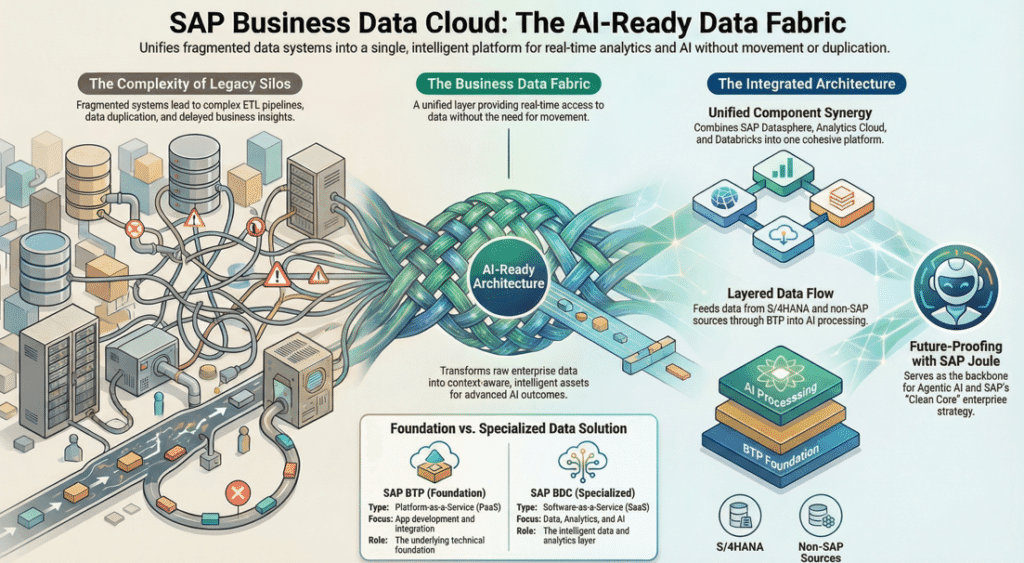
Key Objectives of BDC
- Eliminate data silos
- Enable real-time data access
- Provide AI-ready architecture
- Reduce data duplication
- Simplify data management
Evolution of SAP’s Data Strategy
SAP BW Era
The early days of SAP focused on centralized data warehousing through SAP BW. While effective, it required significant data movement and storage.
SAP HANA and BW/4HANA Transition
With SAP HANA, in-memory computing revolutionized data processing, enabling faster analytics and reporting.
SAP Datasphere Modernization
SAP Datasphere introduced cloud-native data management, allowing more flexible and scalable data integration.
SAP BDC – The Future
SAP Business Data Cloud (BDC) represents the next step—combining data, analytics, and AI into a unified ecosystem.
Understanding Business Data Fabric
Concept of Data Without Movement
One of the most revolutionary aspects of SAP Business Data Cloud (BDC) is its Business Data Fabric approach.
Instead of moving data:
- Data remains in its original location
- Systems access it in real time
- No duplication occurs
This drastically reduces complexity and costs.
Semantic Data Layer Explained
BDC adds a semantic layer, meaning:
- Data understands business context
- It becomes AI-ready instantly
- It improves decision-making accuracy
Architecture of SAP BDC
SAP BTP Foundation
SAP Business Data Cloud (BDC) is built on the powerful SAP Business Technology Platform, which provides scalability and integration.
Core Data Layer
Includes systems like:
- SAP S/4HANA
- SuccessFactors
- External data sources
Data Modeling Layer
Handled by SAP Datasphere, this layer structures and contextualizes data.
Processing and Consumption Layer
Tools like:
- SAP Analytics Cloud
- Databricks
enable analytics, dashboards, and AI capabilities.
Key Features of SAP Business Data Cloud (BDC)
SAP Datasphere Integration
Provides seamless data integration and modeling.
SAP Analytics Cloud Capabilities
Enables real-time dashboards and enterprise planning.
SAP Databricks for AI/ML
Supports advanced machine learning and predictive analytics.
Zero Data Replication Advantage
- Eliminates redundant storage
- Reduces costs
- Improves data accuracy
Real-World Use Cases of SAP BDC
Financial Planning and Forecasting
BDC enables finance teams to:
- Access real-time financial data
- Improve forecasting accuracy
- Make faster decisions
Supply Chain Optimization
Organizations gain:
- End-to-end visibility
- Bottleneck detection
- Improved logistics efficiency
Customer 360 Analytics
Combines multiple data sources to:
- Understand customer behavior
- Improve personalization
- Increase retention
Predictive Maintenance
Using AI capabilities, businesses can:
- Predict equipment failures
- Reduce downtime
- Optimize maintenance schedules
SAP BDC vs SAP BTP
Key Differences Explained
| Feature | SAP BTP | SAP BDC |
| Type | PaaS | SaaS |
| Focus | App Development | Data & AI |
| Usage | Platform | Data Solution |
When to Use Each Platform
- Use SAP BTP for building applications
- Use SAP Business Data Cloud (BDC) for data strategy
Future of SAP Business Data Cloud (BDC)
AI Integration and Joule
BDC powers AI innovations like SAP Joule, enabling intelligent automation.
Clean Core Strategy
Supports system extensions without disrupting core ERP systems.
AI-Driven Enterprises by 2026
SAP Business Data Cloud (BDC) is positioned as the backbone of AI-ready organizations.
Advantages and Business Impact
Faster Decision Making
Real-time insights enable quicker responses.
Reduced Costs
Eliminates ETL pipelines and duplicate storage.
Enhanced Data Governance
Improves data quality and compliance.
Challenges and Considerations
Adoption Complexity
Transitioning to BDC requires planning and strategy.
Skill Requirements
Organizations need skilled professionals in cloud and AI technologies.
Conclusion
SAP Business Data Cloud (BDC) is more than just a data platform—it is the foundation of the intelligent enterprise. By eliminating silos, enabling real-time insights, and supporting AI-driven innovation, it empowers organizations to thrive in a data-first world.
As businesses move toward 2026 and beyond, adopting SAP Business Data Cloud (BDC) will not just be an advantage—it will be a necessity.
FAQs about SAP Business Data Cloud (BDC)
What is SAP Business Data Cloud (BDC)?
It is a SaaS platform that unifies enterprise data for analytics and AI.
How is BDC different from traditional data warehouses?
BDC avoids data movement and provides real-time access.
Is SAP BDC only for SAP data?
No, it supports both SAP and non-SAP data sources.
What is Business Data Fabric?
A system where data stays in place but is accessed in real time
Does BDC support AI and machine learning?
Yes, through integration with tools like Databricks.
Is SAP BDC suitable for small businesses?
It is mainly designed for medium to large enterprises but scalable.
You might also find the following articles interesting
- SAP hana custom code migration
- SAP GTS E4H Migration
- Generative ai for sap consultants
- mastering sap mrp practical guide optimize supply chain planning
- enterprise with sap business ai
- sap s4hana transition guide to data migration
- sap clean core
- SAP S/4HANA private cloud 2025
- introduction sap btp for consultants
- sap consultants productivity with joule
- Migration guide to SAP data migration
- SAP btp guide to app development
- Transformation journey 4hana implementation
- Empowering enterprises with SAP solutions
- blackline tool vs traditional process
- Sap cutover plan a comprehensive guide
- Fiori Configuration Guide
- SAP ECC to S4HANA data migration
- earn sap btp
- Retail insights with sap car
- leanix an introductory guide
- building side-by-side extensions on SAP BTP
- sap ecc vs s4 hana key changes and benefits
- sap ides
- Understanding RFNO in SAP s4hana
- SAP Clean Core
- SAP ABAP beginner’s journey
- Grow with sap vs rise with sap comparison
- Rise with sap
- Year-end activities in sap
- SAP TM Transaction codes
- ethical ai development
- sap migration data configuration tools
- s4hana custom code migration
- SAP EWM integration
- sap project intelligence network
- advanced production integration with SAP EWM
- Credit management comparison of sap fscm
- SAP EWM


